






Distinguishing Moissanite and Diamond: 8 Key Differences
Key Takeaways
- Diamonds and Moissanite are both rare gemstones, possessing a brilliant beauty that makes them adored by many who love Jemmia diamond jewelry. Both types of stones have many similarities, so how can...

Diamonds and Moissanite are both rare gemstones, possessing a brilliant beauty that makes them adored by many who love Jemmia diamond jewelry. Both types of stones have many similarities, so how can we distinguish Moissanite and Diamonds? Let's learn about Diamonds and Moissanite and how to distinguish them in the following article from Jemmia.
Definition of Natural Diamond, Lab-Grown Diamond, and Moissanite
To distinguish Moissanite and Diamonds, we first need to understand natural diamonds, lab-grown diamonds, and Moissanite. Here are the definitions of these stones:
What is a Natural Diamond?
Natural diamonds are gemstones formed over millions of years under high pressure and temperature deep within the Earth. Diamonds are composed of 99.95% pure carbon, with the remainder being trace elements like nitrogen. Natural diamonds are also the hardest known natural mineral. The hardness of a diamond is 10/10 on the Mohs hardness scale.
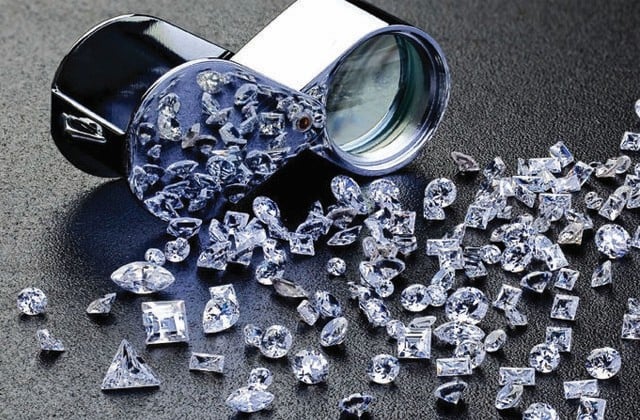
Natural diamond is a gemstone formed over millions of years
Natural diamonds can have varying degrees of clarity, from completely transparent to having minor inclusions. Diamond colors come in many shades, with colorless (D) being the most common, followed by yellow, pink, blue, etc.
What is a Lab-Grown Diamond?
Lab-grown diamonds, also known as synthetic diamonds, are stones produced in a laboratory with optical and physical properties similar to natural diamonds. Lab-grown diamonds are created by simulating the high-pressure and high-temperature environment similar to the one where natural diamonds form deep within the Earth.
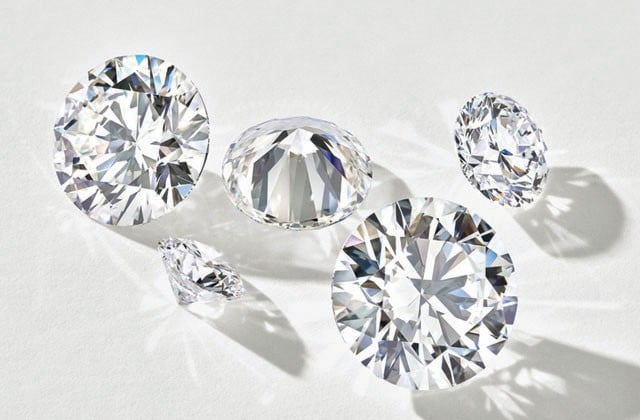
Lab-grown diamonds are also called synthetic diamonds
The HPHT (High Pressure, High Temperature) method and the CVD (Chemical Vapor Deposition) method are the two most common methods for creating lab-grown diamonds.
Lab-grown diamonds offer many advantages such as lower cost, diverse sizes, and rich colors. However, lab-grown diamonds are less unique than natural diamonds.
What is Moissanite?
Moissanite is a mineral rarely found in nature, often discovered in meteorites. Due to limited reserves and high extraction costs, Moissanite is currently primarily produced in laboratories by combining carbon and silicon through thermal decomposition.
Thanks to its diamond-like brilliance and lower price, Moissanite is mainly used in the jewelry industry to craft rings, earrings, necklaces, etc.
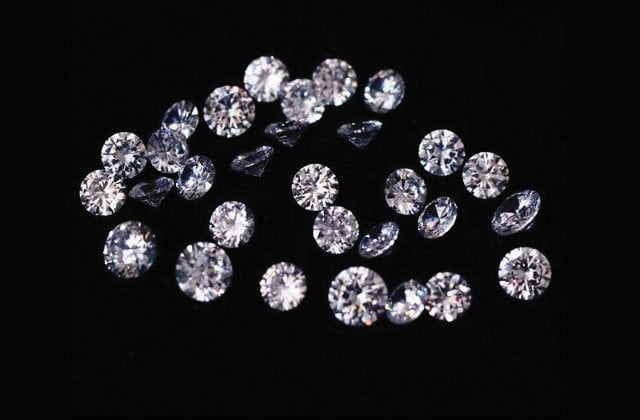
Moissanite is primarily produced in laboratories by combining carbon and silicon through thermal decomposition
Distinguishing Diamonds and Moissanite
Here are the comparisons and ways to distinguish between Diamonds and Moissanite:
Comparison of Moissanite and Diamonds: Brilliance
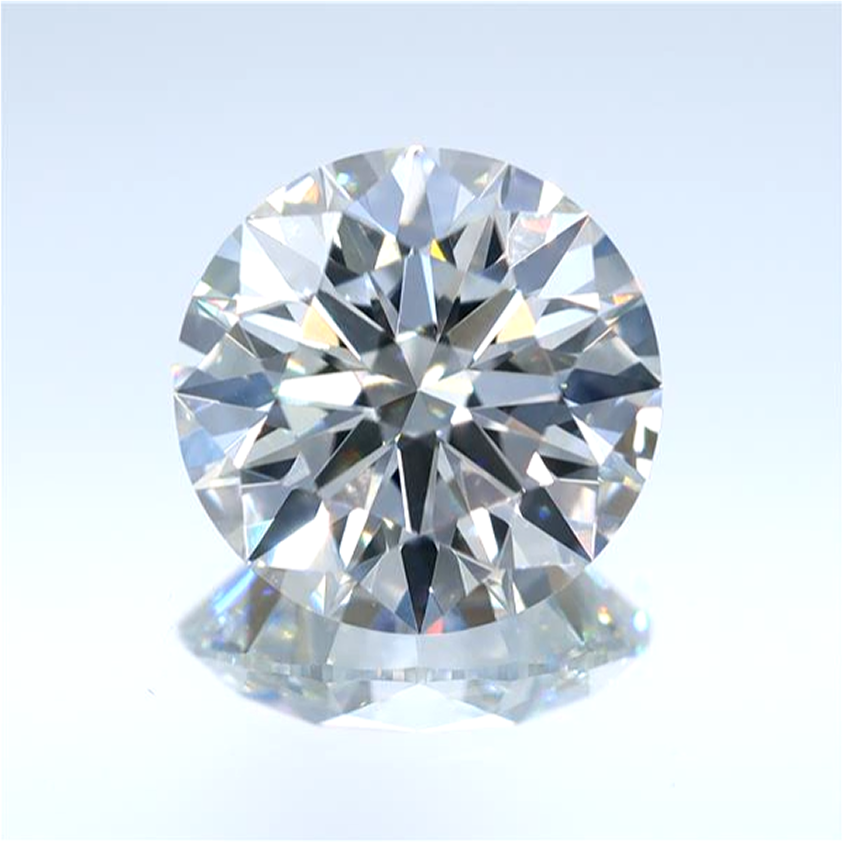
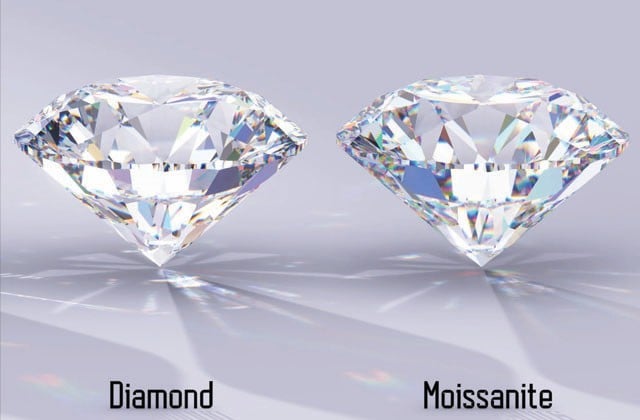
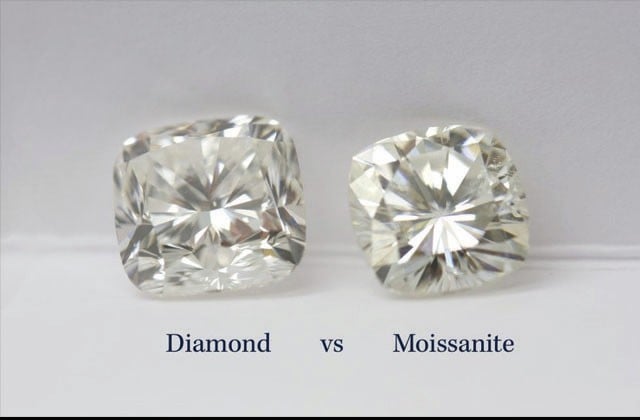
Both diamonds and Moissanite are brilliantly sparkling stones. The brilliance or sparkle of a stone depends on its refractive index. This is also the biggest difference when distinguishing Moissanite from Diamonds.
Moissanite has a higher refractive index than diamonds. The refractive index of Moissanite ranges from 2.65 to 2.69, while the refractive index of diamonds is 2.42. Thanks to its high refractive index, Moissanite has a more dazzling brilliance than many other gemstones, offering a colorful sparkle. Diamonds, on the other hand, have a moderate sparkle, not overly dazzling, making them more refined and elegant.
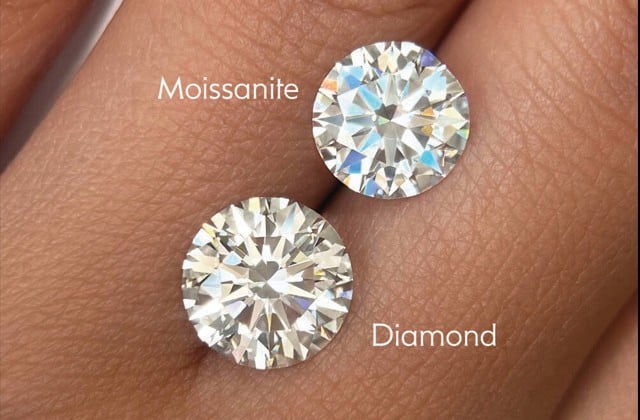
Comparison of Moissanite and Diamonds: Brilliance
Comparison of Moissanite and Diamonds: Hardness and Durability
Both Moissanite and diamonds have very high hardness. Moissanite reaches 9.5 on the Mohs hardness scale, while natural diamonds are harder, reaching 10 Mohs.
With a hardness of 9.5 and 10, both Moissanite and diamonds are extremely durable stones. Therefore, when crafting jewelry, you don't have to worry about the stones being damaged by impact or breakage.
Comparison of Moissanite and Diamonds: Hardness and Durability
Both gemstones can withstand high temperatures, so you can be assured that jewelry set with diamonds or Moissanite will be less likely to be damaged by exposure to high temperatures during use. Additionally, the hardness of both stones is sufficient to alter jewelry designs without fear of damage.
Comparison of Moissanite and Diamonds: Color and Fire from Light Refraction
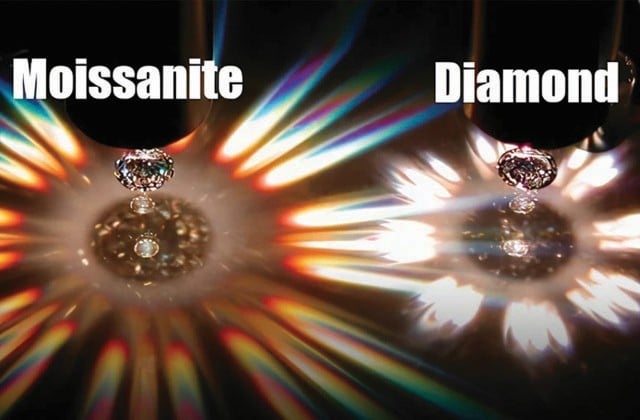
Although Moissanite is lab-created and considered a “colorless gemstone,” this is not entirely true. Under certain lights, Moissanite can reflect light into different colors.
Moissanite refracts light into a wide spectrum of colors, while diamonds refract light in shorter, colorless flashes.
Comparison of Moissanite and Diamonds: Color and Fire from Light Refraction
This creates a significant advantage when comparing Moissanite and diamonds. If you love rainbow flashes, Moissanite is suitable. However, some customers prefer the refined sparkle of diamonds.
Comparison of Moissanite and Diamonds: Clarity
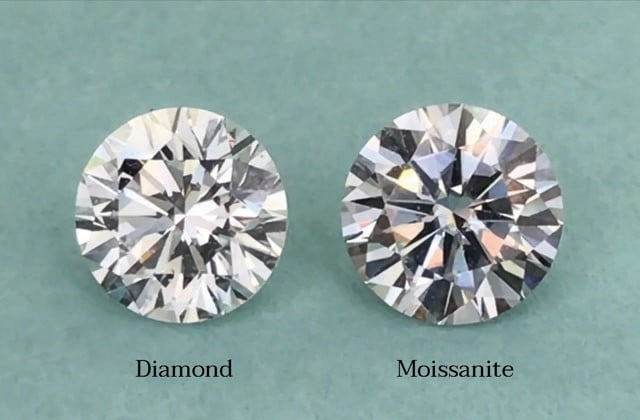
Since most Moissanite is lab-produced, its clarity can be controlled. Inclusions in Moissanite are usually very small and do not affect its clarity or sparkle.
Diamonds, similar to Moissanite, also have very small inclusions. Diamond clarity is graded on 11 levels by the GIA, from Flawless (FL) to Included (I). Each grade significantly impacts the diamond's value.
Comparison of Moissanite and Diamonds: Clarity
Comparison of Moissanite and Diamonds: Price
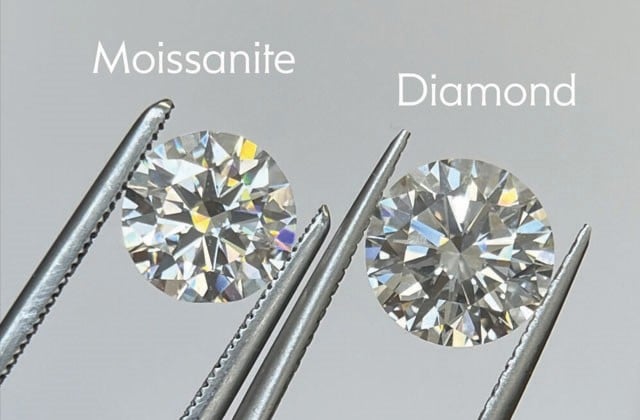
Price is one of the most important factors when comparing Moissanite and Diamonds. Diamonds are valuable assets with high resale value and the potential to appreciate over time due to limited supply, high hardness, and liquidity.
Moissanite, on the other hand, is a stone with no trade-in value and depreciates annually due to abundant artificial production. Lab-grown Moissanite is significantly less expensive than diamonds and other gemstones.
Lab-grown Moissanite is significantly less expensive than diamonds
Comparison of Moissanite and Diamonds: Chemical and Physical Properties
Next, let's compare Moissanite and Diamonds based on the physical and chemical characteristics used by scientists and experts in the table below:
| Diamond | Moissanite | |
| Composition | Primarily pure carbon | Silicon and carbon |
| Color | 12 pure colors: yellow, blue, pink, orange, green, brown, gray, purple, violet, red, white, and black. | Almost all colors including gray, green, yellow, brown, blue, purple, pink, and gold,… |
| Luster | Adamantine | Brilliant to metallic luster |
| Common Formation Method | Natural, lab-grown | Primarily lab-created |
| Refractive Index | 2.42 | 2.65 – 2.97 |
| Value | High value | Average value is only 1/10 of diamond |
| Crystal System | Cubic | Hexagonal |
| Specific Gravity | 3.52 | 3.218 – 3.22 |
Comparison of Moissanite and Diamonds: Ethical Considerations in Sourcing
Gemstone mining can raise social and political issues. Therefore, if you want to sleep soundly, choose lab-created Moissanite. Moissanite is not associated with unethical mining practices, such as labor exploitation and indirect support for political conflicts.
Comparison of Moissanite and Diamonds: Ethical Considerations in Sourcing
Alternatively, you can choose diamonds mined from Canada. This country is known for its sustainable diamond supply, free from conflict and environmentally friendly. If you are unsure about the origin, you can opt for lab-grown diamonds.
Comparison of Moissanite and Diamonds: Certification
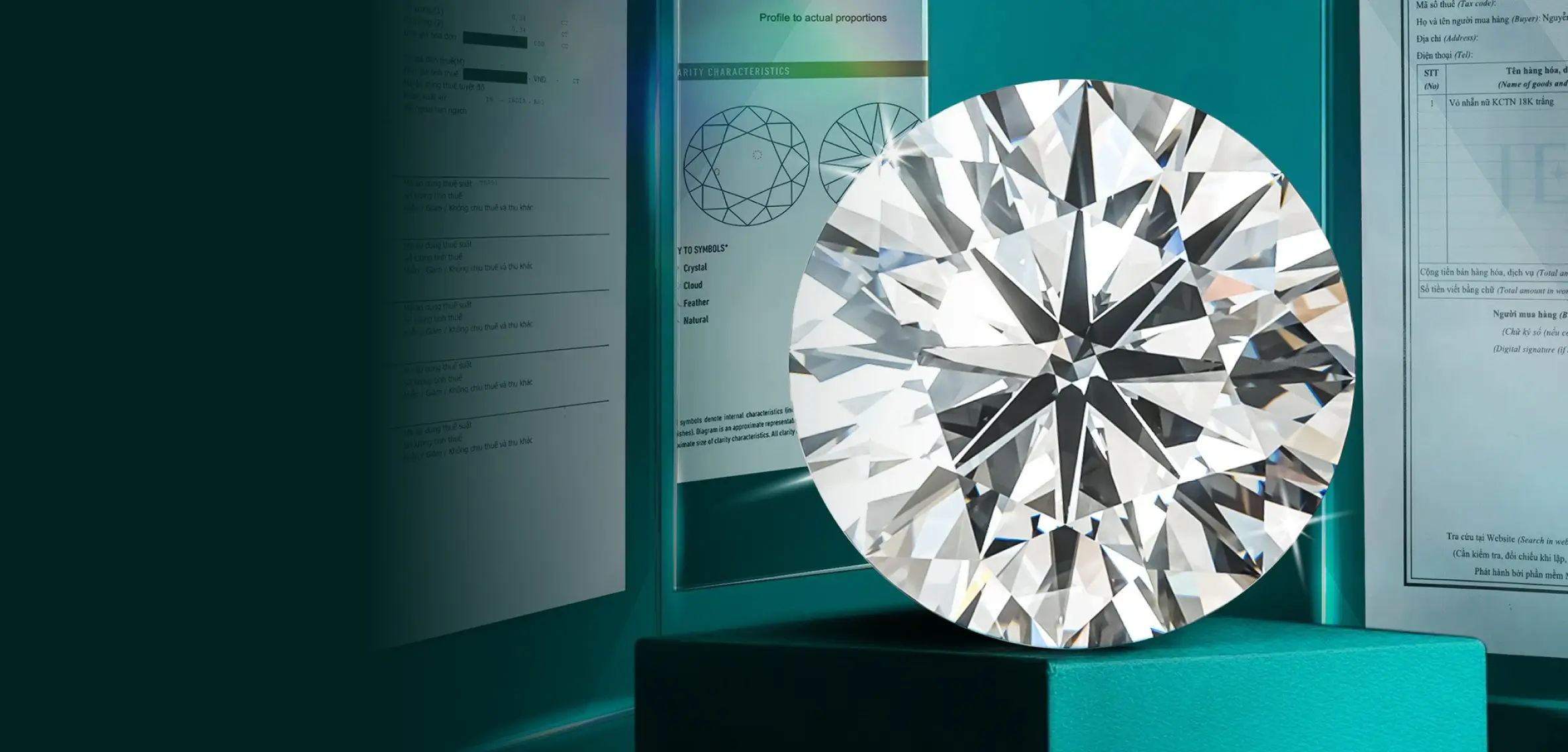
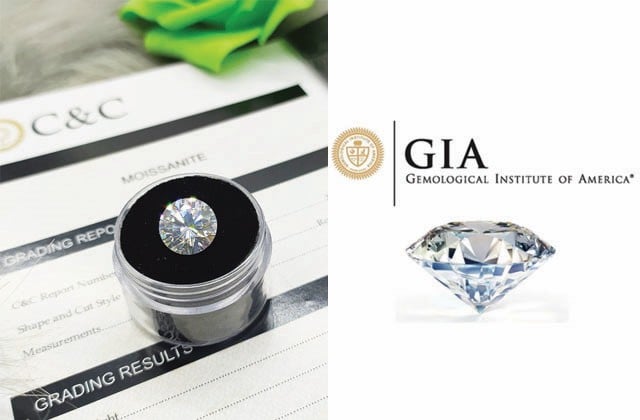
Natural diamonds are certified by organizations such as the Gemological Institute of America (GIA), the American Gem Society (AGS), the European Gemological Laboratory (EGL), and the International Gemological Institute (IGI).
Meanwhile, Moissanite is typically certified by C&C – an international organization founded by the discoverer of Moissanite.
Comparison of Moissanite and Diamonds: Certification
Jemmia's article above has shared with everyone the simplest way to distinguish Moissanite and Diamonds. It helps you understand these two gemstones better, thereby choosing the most suitable stone when purchasing. Especially, if you are interested in full diamond wedding rings, understanding the differences between these two stones will help you make the most accurate and worthy choice for your special day. Follow Jemmia for more knowledge about Diamonds and gemstones.
See more: Diamond prices with great offers at Jemmia Diamond