












What's Harder Than Diamond? Top 6 Materials Harder Than Diamond
Key Takeaways
- We often think that diamond is the hardest material in the world, but in reality, is there any material harder than diamond? The answer is yes. So, what is harder than diamond?...

We often think that diamond is the hardest material in the world, but in reality, is there any material harder than diamond? The answer is yes. So, what is harder than diamond? Let us find out through the following article from Jemmia!
How hard is diamond?
Diamond is a carbon crystal with a special structure. The carbon atoms in diamond are arranged in a very regular geometric shape and are linked together by extremely strong "electron pairs". This structure creates a stable network of bonds, making diamond extremely hard and difficult to break.
Diamond is a carbon crystal where carbon atoms are arranged in a face-centered cubic lattice. Each carbon atom will bond with four other carbon atoms through covalent bonds, creating an extremely strong three-dimensional network. This explains why diamond has a very high hardness.
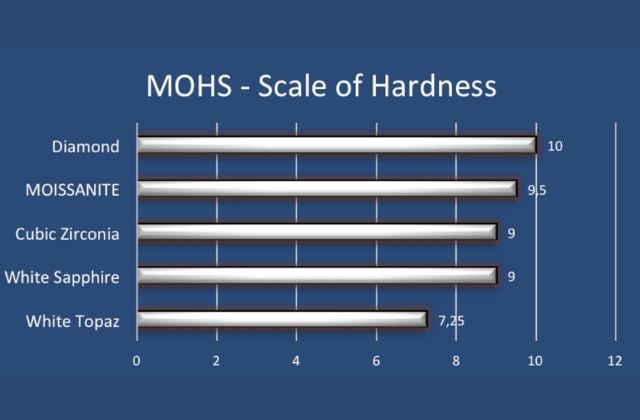
The hardness of diamond is rated as 10 on the Mohs hardness scale
The hardness of diamond is evaluated by the Mohs hardness scale, and diamond is ranked at level 10 – the highest level. This means that diamond can resist scratches from other materials. Diamond is also widely used in cutting and grinding tools thanks to this property.
Top 6 Materials Harder Than Diamond
Let's explore the 6 materials harder than diamond below:
Graphene
Graphene – has a hexagonal lattice structure of carbon atoms and is only 1 atom thick. After successful preparation, graphene flakes are expected to become the most revolutionary material of the 21st century. Graphene is the most basic structural component of carbon nanotubes and is applied in many situations.
At the same thickness, Graphene is considered the strongest material, with unparalleled thermal and electrical conductivity, and light transmittance close to 100%. In 2010, the Nobel Prize in Physics was awarded to Andre Geim and Konstantin Novoselov for their experiments on Graphene.
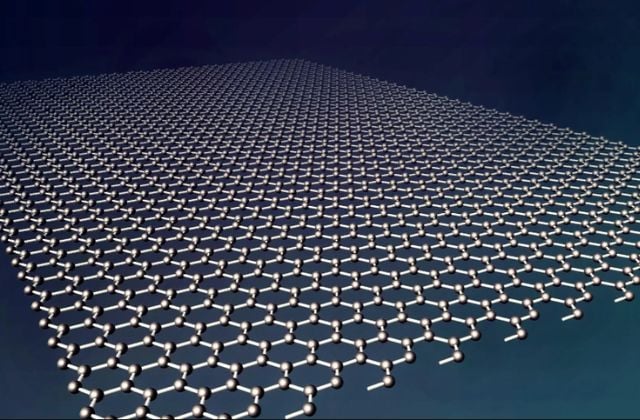
Graphene is a material known as the hardest on the planet
To date, Graphene remains the thinnest material we know. This is also considered one of the fastest records in physics, as it took only 6 years from research to receiving the award.
Buckypaper
Since the late 20th century, carbon nanotubes have been known as materials harder than diamond. This substance belongs to the hexagonal crystal system, with an overall elliptical structure and excellent stability compared to any other structure. If you combine a large number of nanotubes into a flat sheet, you will get a thin paper called Buckypaper.
For comparison, each nanotube forming Buckypaper has a diameter of only 2-4 nanometers, and its structure is very strong, allowing it to be combined into large-area material sheets. Its weight is only 10% of steel, but its hardness is hundreds of times greater. In addition, this material is also fire-resistant, highly thermally conductive, and has superior electromagnetic shielding capabilities. Buckypaper has promising applications in many fields: material science, electronic components, and even biology.
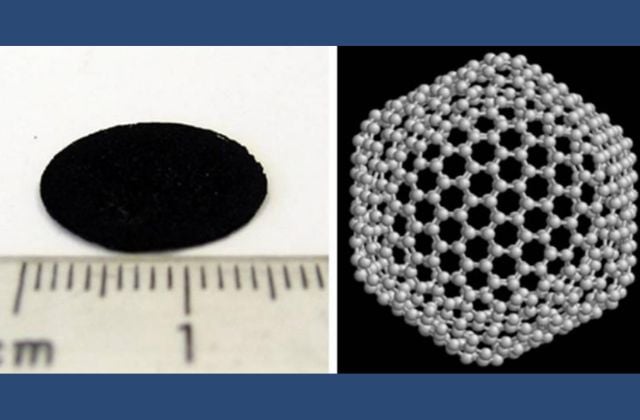
Buckypaper looks like old-fashioned carbon paper
Besides Buckypaper, there is also a similarly hard structure called buckyball, formed by 60 carbon atoms bonded together. Buckyball is also a naturally occurring material formed in certain cosmic environments. Although it has been applied in nanotechnology, it has not yet reached the desired production volume. It is not included in the list because it has not yet demonstrated its applicability on a macro scale.
Palladium-based metallic glass
Two important properties of all physical materials are strength and toughness. Strength is needed to deform a material, while toughness is the force required to break or fracture it. Most ceramic materials have high strength but low toughness and are easily broken if clamped too tightly or dropped. Elastic materials like rubber are the opposite: not easily broken but easily deformed and have low hardness.
Almost all glass materials are brittle, have low toughness but high strength; even tempered glass is not hard enough. In 2011, researchers invented a new type of metallic glass consisting of 5 elements: phosphorus, silicon, silver, palladium, and germanium. Palladium can form shear bands, allowing the glass to deform plastically when acted upon and not break directly.
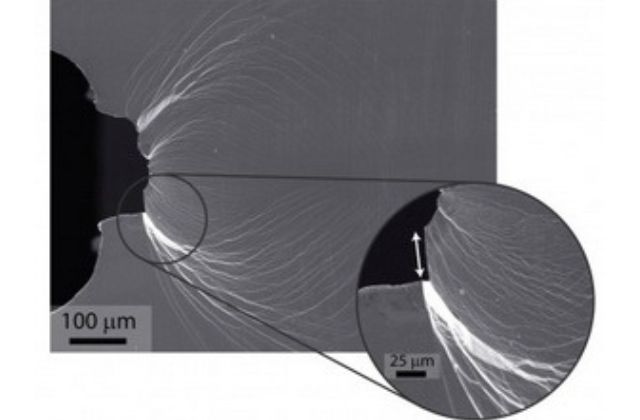
Metallic glass combines the properties of glass and metal
This is a material with extremely high strength and toughness. It easily outperforms all existing types of steel and glass because it is the hardest non-carbon material in the world.
Dyneema
Dyneema is a high-molecular-weight thermoplastic polyethylene polymer. Most molecules we know have only a few thousand atomic mass units. But the polyethylene chain has an extremely long molecular weight. The weight of a molecule can reach tens of millions of atomic mass units.
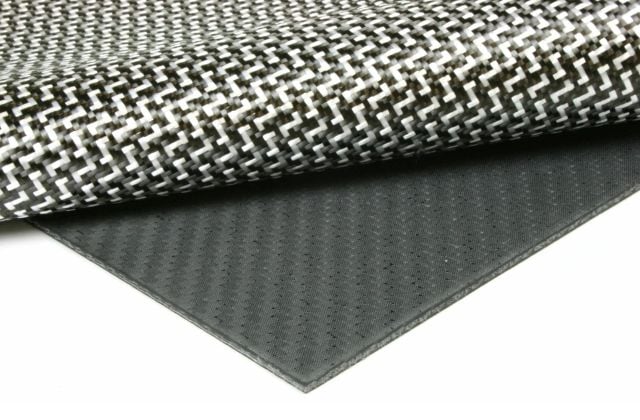
Dyneema – a synthetic polyethylene plastic, with the strongest fibers in the world
With such long molecular chains, the interaction between molecules is significantly increased. In fact, this material has the highest strength among all known thermoplastic plastics. It is considered the strongest fiber material in the world, surpassing all ropes and cables on the market. Additionally, Dyneema is lighter than water and bulletproof.
Lonsdaleite
Diamond is actually a cubic crystal, while Lonsdaleite belongs to the hexagonal crystal system. Lonsdaleite has a similar composition to diamond but is 58% harder than diamond. Therefore, Lonsdaleite is also called hexagonal diamond (a form of carbon with a hexagonal lattice).
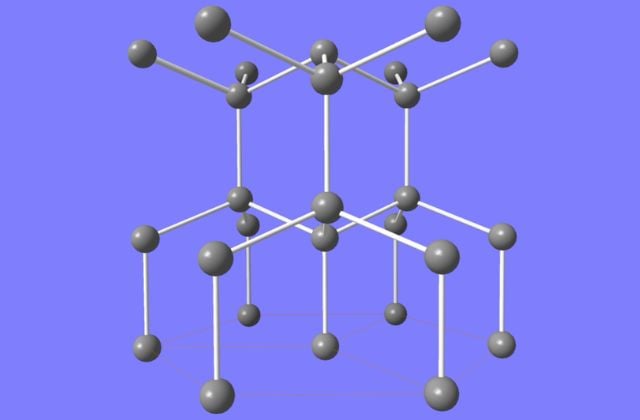
Lonsdaleite has a hexagonal diamond structure – a variant of carbon
In nature, it is formed when meteorites containing graphite collide with Earth. The high heat and pressure of graphite are preserved. Lonsdaleite was first discovered in 1967 when the Canyon Diablo meteorite exhibited very, very small crystals, all related to diamonds.
Wurtzite boron nitride
Besides carbon, many atoms combine with other substances to form crystals. Boron nitride is one of them. Boron and nitrogen are ranked 5th and 7th in the periodic table, respectively. When these two elements combine, they form many compounds, including amorphous solids, hexagonal crystal systems (similar to graphite), cubic crystal systems (similar to diamond, but with a slightly inferior structure), and wurtzite.
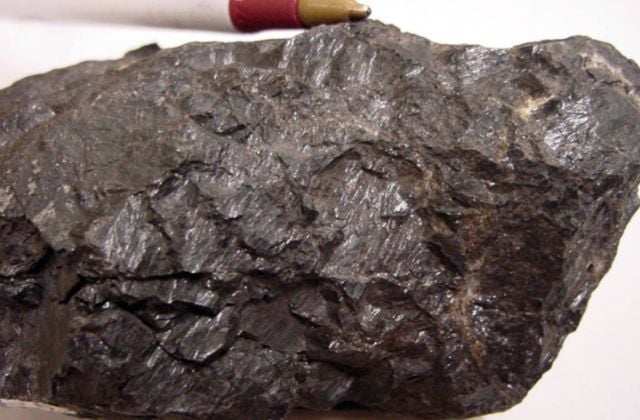
Wurtzite boron nitride is on the list of materials harder than diamond
This material is formed during volcanic eruptions, and humans have only found a very small amount of it so far. Therefore, science has not practically tested its hardness. The latest simulations suggest that it can form a structure up to 18% harder than diamond.
Here, Jemmia hopes that the content shared in this article will help you learn more about what is harder than diamond. This will help you gain a more comprehensive understanding of diamond knowledge!
Reference: Diamond prices based on the 4Cs at Jemmia Diamond